Your child loves playing defensive line. But his shoulders hurt. Every Sunday after a game, he is icing both shoulders. You have started to worry.
Is it a labrum issue? A rotator cuff problem? Do you need to see a doctor?
Maybe. But before you schedule an MRI and start talking about surgery, let me ask you a different question:
How are his hands?
At Elite Defensive Line Academy, we see young defensive linemen every week who have chronic shoulder pain. Many of their parents have already spent hundreds of dollars on doctor visits. Some have even been told their child needs off-season surgery.
Then we watch them play. And within five minutes, we see the real problem.
Their hand placement is destroying their shoulders.
Here is what is happening – and how to fix it without surgery.
The Connection Nobody Talks About
Your shoulder is a ball-and-socket joint. It is designed for a huge range of motion. That is good for throwing a baseball. It is terrible for absorbing violent impacts from a 280-pound offensive lineman.
When your defensive lineman punches with poor technique, the force of the impact goes directly into his shoulder joint. Not through his core. Not through his legs. Straight into the labrum, the rotator cuff, and the surrounding tendons.
Do that 50 times per game, 10 games per season, for a few years. Now you have chronic shoulder pain.
The fix is not surgery. The fix is fixing his hands.
Mistake #1: Punching with Straight Arms
What it looks like: Your player extends his arms fully before making contact. His elbows lock out. His hands slap the offensive lineman’s chest from maximum distance.
What happens to the shoulder: The impact travels straight back into the joint. There is no bend in the elbow to absorb force. The shoulder takes everything.
The fix: Teach contact with elbows bent at 90 degrees. Imagine punching through a board – you do not lock your elbow when you make contact. Same here.
The shoulder-saving difference:
| Arm position | Where force goes | Shoulder stress |
|---|---|---|
| Locked out (straight) | Directly into shoulder joint | High |
| Bent (90 degrees) | Through core and into legs | Low |
Mistake #2: Hands Too Wide (The Chicken Wing)
What it looks like: Your player’s hands land outside the offensive lineman’s shoulder pads. His elbows flare out to the sides like chicken wings.
What happens to the shoulder: The wide hand placement forces the shoulder into external rotation – the least stable position for the joint. One good punch from the OL and something pops.
The fix: Hands land inside the frame – on the numbers, the sternum, or the breastplate. Thumbs point up or slightly in. Elbows stay tight to the body.
The test: Have your player stand in front of you with his hands on your chest. If his elbows are wider than his hands, he is chicken-winging. Fix it.
Mistake #3: Punching THEN Extending
What it looks like: Your player makes contact with bent elbows, but then he pushes. He extends his arms fully while still pressing.
What happens to the shoulder: The pushing motion requires the rotator cuff to stabilize the joint while under load. This is a recipe for tendinitis and fraying.
The fix: Punch, then reset. Do not push. A punch is a violent, sudden impact. After the punch, hands come back to the chest and prepare for the next move. Pushing is slow and shoulder-destroying.
The analogy: A punch is like a door slam. You do not keep pushing the door after it closes. Same with your hands.
Mistake #4: One-Arm Reaching
What it looks like: Your player tries to rip or swim with one arm while the other arm hangs down. The reaching arm is fully extended and isolated.
What happens to the shoulder: All of the force from the offensive lineman’s block goes into that single, unprotected shoulder joint. No help from the other arm. No help from the core.
The fix: The off-hand must always be attached to the blocker’s chest. If one hand is ripping, the other hand is controlling. No dead arms. Ever.
The Shoulder-Saving Hand Placement Drills
These drills do not require heavy weights or expensive equipment. Just correct technique.
Drill #1: The Wall Punch (Check Your Reach)
Setup: Have your player stand an arm’s length from a wall. Place both hands on the wall with elbows bent 90 degrees.
The movement: Punch the wall by extending arms 6 inches (not fully). Stop. The hands should still be 6-12 inches from the wall when elbows are bent.
What this teaches: Contact happens with bent elbows. Always.
Reps: 20 slow punches. 20 fast punches. Every day.
Drill #2: The Partner Chest Punch (Feedback Drill)
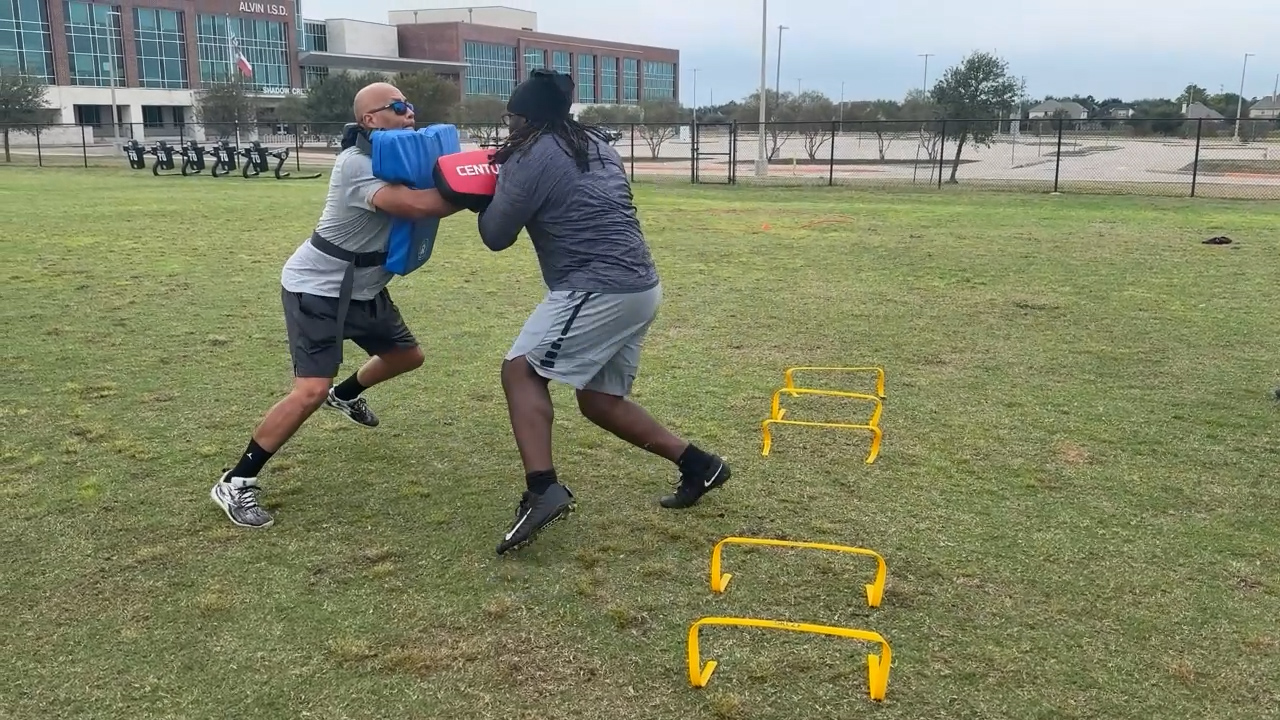
Setup: You stand in front of your player holding a pad or even just a pillow against your chest.
The movement: Your player punches the pad with both hands, elbows bent. You immediately say “wide” or “inside” based on where his hands land.
What this teaches: Inside hand placement becomes muscle memory.
Reps: 30 punches. Have him close his eyes for the last 10 – he should feel the correct spot.
Drill #3: The One-Arm Control Drill
Setup: Your player holds a bag or a pillow against a wall with his left hand only. His right hand is free.
The movement: He rips or swims with the right hand while maintaining pressure with the left hand. The bag should not fall.
What this teaches: No dead arms. Ever.
Reps: 10 each side. Switch.
When Should You Actually See a Doctor?
I am a defensive line trainer, not a physician. There are times when shoulder pain is truly medical.
See a doctor immediately if:
- Your player cannot lift his arm above shoulder height
- There is visible swelling or deformity
- The pain woke him up from sleep
- He heard a “pop” followed by pain
See a doctor within a week if:
- Pain has lasted more than 2 weeks despite rest
- He has lost throwing velocity (for two-sport athletes)
- The shoulder feels “loose” or like it might pop out
Try fixing hand placement first if:
- Pain only happens during or after football (not during other activities)
- Both shoulders hurt equally (labrum tears are usually one side)
- Pain goes away after a few days of rest
In our experience training defensive linemen across Pearland, Katy, Alvin, and the greater Houston area, about 70% of chronic shoulder pain cases improve dramatically once hand placement is corrected.
That is not a guess. That is watching hundreds of athletes over multiple seasons.
The Parent’s Checklist: Is Your Player at Risk?
Answer these five questions honestly:
| Question | Yes | No |
|---|---|---|
| Does your player punch with straight elbows? | ☐ | ☐ |
| Do his hands land outside the OL’s shoulders? | ☐ | ☐ |
| Does he push after contact instead of punching? | ☐ | ☐ |
| Does he ever leave one arm hanging down? | ☐ | ☐ |
| Has he had shoulder pain for more than 2 weeks? | ☐ | ☐ |
3 or more “Yes” answers: His hand placement is almost certainly causing his shoulder pain.
Real Talk: Surgery Is Not a Shortcut
I have had parents tell me, “Maybe we should just get the surgery and fix it once and for all.”
Here is what I tell them: Surgery fixes the damage. It does not fix the cause. If your child has poor hand placement before surgery, he will have poor hand placement after surgery. He will just hurt his surgically repaired shoulder faster.
Fix the technique first. See if the pain goes away. Most of the time, it does.
Ready to Fix the Root Cause – Not Just the Symptoms?
You have read the mistakes and the drills. Now your child needs someone to watch his hands every single rep and correct them until the bad habits disappear.
If you have been looking for someone who understands that shoulder health starts with hand placement, come to Elite Defensive Line Academy. We do not just train pass rush moves. We train bodies that last.
Whether you live in Pearland, Katy, Alvin, Missouri City, Friendswood, Pasadena, or anywhere else near Houston, we are here to help. Our athletes play longer because we teach technique that protects their joints.
📍 Where we train: Shadow Creek High School, 11850 Broadway St., Pearland, TX 77584
🧢 Bring: Cleats, gloves, water (no water on site)
🚽 Bathrooms: Go before you arrive