
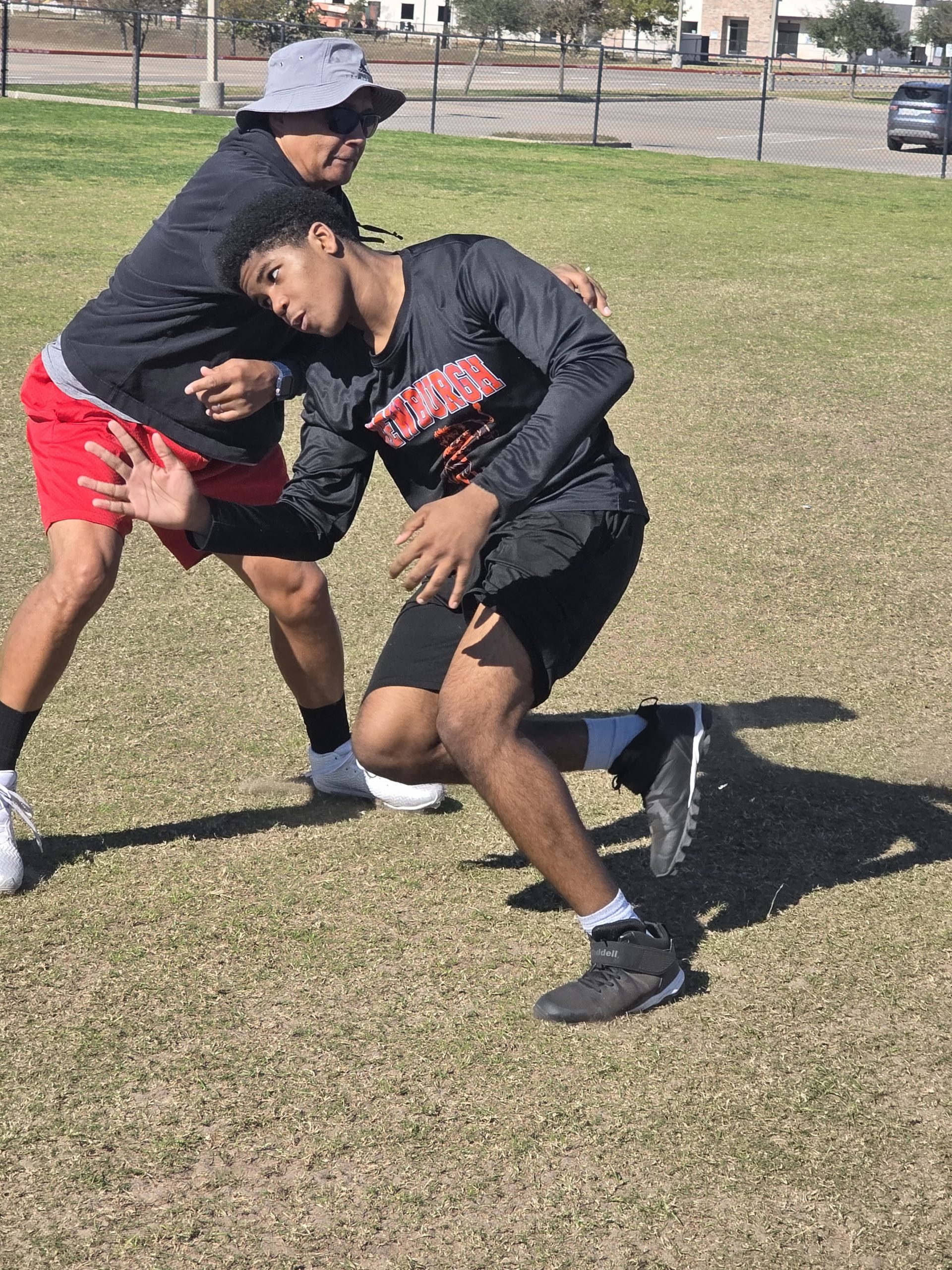
Your defensive lineman works hard at practice. He does the drills. He stays after for extra reps.
But on Friday night, the same offensive tackle beats him play after play.
The problem is not effort. It is information.
Most high school defensive linemen walk onto the field knowing nothing about their opponent. They react. They hope. They lose.
Elite defensive linemen spend 15 minutes on film study before game day. They know the tackle’s favorite move. They know his weak foot. They know exactly what he will do before the ball snaps.
At Elite Defensive Line Academy, we require every athlete we train to keep a tendency chart. It takes a quarter of a hour. It wins games.
Here is exactly how to do it.
Why 15 Minutes Is All You Need
You are not becoming an NFL coordinator. You do not need to watch every play.
You need to answer five questions about the offensive tackle your child will face:
- Does he fire out or wait?
- Which foot does he favor in pass pro?
- Does he overset to the outside?
- Does he lunge or stay patient?
- What is his go-to recovery move when beaten?
Fifteen minutes of focused charting answers all five. Here is the exact method.
What You Need to Get Started
- Hudl or YouTube highlights of the opposing team (latest 2-3 games)
- Pen and paper (or a notes app)
- 15 minutes of uninterrupted time
- Your defensive lineman watching with you
Pro tip: Do this on a Tuesday or Wednesday night. Not the night before the game. Give your player time to mentally rehearse the tendencies.
The 15-Minute Tendency Chart
Set a timer. Follow this exact breakdown:
| Time | Task | What to track |
|---|---|---|
| 0:00-2:00 | Watch 10 run plays at the tackle | Does he fire out low? Does he reach or drive? |
| 2:00-4:00 | Watch 10 pass plays at the tackle | Does he kick-slide or set vertically? |
| 4:00-6:00 | Track footwork on pass plays | Which foot does he move first? Does he overset? |
| 6:00-8:00 | Watch 5 plays where the tackle loses | What does he do when beaten? Hold? Lunge? Recover? |
| 8:00-10:00 | Watch 5 short-yardage plays | Does he change his stance or technique? |
| 10:00-12:00 | Review notes and identify 3 tendencies | Write down the three most reliable tells |
| 12:00-15:00 | Create a 3-play game plan | What move vs each tendency? |
That is it. Fifteen minutes. A complete scouting report.
The 5 Most Common Tackle Tendencies (And How to Attack Them)
Tendency #1: The Oversetter
What it looks like: On pass plays, the tackle takes a huge first step to the outside. He is terrified of the speed rush.
How to attack: Sell a speed rush for one step, then cross back inside. The Ghost move (from our previous post) destroys oversetters.
Tendency #2: The Lunger
What it looks like: The tackle throws his hands early and leans forward. He is off balance before you even engage.
How to attack: Club-rip. One hard strike to his outside shoulder, then rip through as he falls forward. He cannot recover.
Tendency #3: The Waiter
What it looks like: The tackle waits for you to make the first move. He never attacks. He is reactive.
How to attack: Bull rush. He is not used to initiating contact. Hit him in the chest with violent hands and drive through his heels.
Tendency #4: The Grabber
What it looks like: When beaten, the tackle grabs jersey, shoulder pads, or facemask. He holds rather than loses.
How to attack: Swipe his hands down hard on first contact. Keep your hands inside his frame. If he grabs, sell it to the referee with a head snap.
Tendency #5: The Heavy-Footed
What it looks like: The tackle moves slowly laterally. His first step is heavy and late.
How to attack: Pure speed rush around the outside. No move needed. Just beat his feet to the corner.
The Printable Tendency Chart (Copy This)
You can copy and paste this into a note or print it for your player:
text
OFFENSIVE TACKLE TENDENCY CHART
Opponent: _______________  Number: _______  Position: _______

RUN BLOCK TENDENCIES:
[ ] Fires out low      [ ] Pops up high     [ ] Zone steps
[ ] Down blocks        [ ] Pulls            [ ] Cut blocks

PASS BLOCK TENDENCIES:
[ ] Kick-slide         [ ] Vertical set     [ ] Jabs first
[ ] Oversets outside   [ ] Oversets inside  [ ] Lunges

WEAKNESSES:
[ ] Slow first step    [ ] High pad level   [ ] Catches punches
[ ] No anchor vs bull  [ ] Grabs when beat  [ ] Quits on plays

GAME PLAN – MY FIRST 3 MOVES:
1st down: _______________
2nd down: _______________
3rd down: _______________

SIGNATURE TELL (one thing he always does):
_________________________________________
How to Use the Chart on Game Day
The chart is useless if it sits in a locker.
Pre-game (20 minutes before kickoff): Your player reads the chart one time. Out loud. Then puts it away.
First series: He tests tendency #1 on the first play. If it works, keep hitting it. If not, move to tendency #2.
After each quarter: He mentally reviews what is working and adjusts.
Do not overthink. Three tendencies. Three moves. That is all a high school defensive lineman needs.
Real Example: How a 15-Minute Chart Won a Game
Last season, one of our defensive line training athletes spent 15 minutes charting an opposing left tackle.
He found:
- Tackle overset outside on every pass play
- Tackle had a slow right-foot kick-slide
His game plan:
- Ghost move on 1st down
- Speed rip outside on 2nd down (attack the slow right foot)
Result: 3 sacks. 3 tackles for loss. His team won by 14 points.
The tackle was stronger. He was bigger. But our athlete knew exactly what was coming.
The Parent’s Role in Film Study
You do not need to be a coach to help with this.
What you can do:
- Pull up Hudl or YouTube on a laptop or TV
- Run the timer for the 15-minute breakdown
- Ask guiding questions (“Did his first step go outside or inside?”)
- Help fill out the tendency chart
What you should not do:
- Take over and do the chart for your player
- Add too many tendencies (three is enough)
- Make it take longer than 15 minutes
The goal is to teach your child how to study film. Not to do it for him.
What About Freshman or JV Players?
Younger players often face opponents with less film available. That is fine.
The mini-version (10 minutes):
- 5 minutes watching the first quarter only
- Find just one tendency
- Build a game plan around that one tell
One tendency is enough for a freshman. Next year, add a second. By junior year, your player will be charting like a pro.
The Bottom Line
Most high school defensive linemen never watch a single play of their opponent.
Your child can spend 15 minutes and have a massive advantage on Friday night.
That is not talent. That is preparation. And preparation beats talent when talent does not prepare.
Want to Learn More Game-Winning Techniques?
You have read the charting method. Now your child needs to practice applying these reads against live offensive linemen.
If you have been searching for defensive line training near me that teaches the mental and technical game, come train with us at Elite Defensive Line Academy.
We incorporate film study principles into every practice. We are the best d line training near me and football training near me in the Houston area. Our summer football camps in Texas teach players how to win before the snap ever happens.
📍 Location: Shadow Creek High School, 11850 Broadway St., Pearland, TX 77584
📧 Contact: Reach out through our website
🚽 Note: No bathrooms on site – plan your arrival accordingly
👉 Sign up now for football training in Houston – ask about our film study add-on sessions